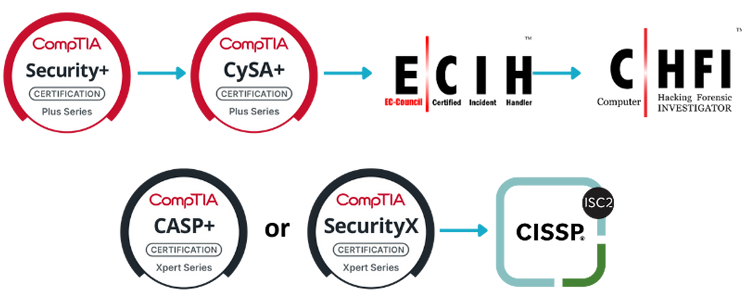
Explore Different Career Pathways with Eric Reed
Explore Different Career Pathways with Eric Reed
IT Support Specialist
Network Administrator
Linux Systems Administrator
Cloud Security Engineer
Cybersecurity (SOC) Analyst
Penetration Tester / Ethical Hacker
Digital Forensics Investigator
Incident Responder
Security Engineer
Security Architect
Security Consultant
DevSecOps Engineer
GRC Analyst
Red Team Operator
Chief Information Security Officer (CISO)

IT Support Specialist
 Salary Range: $32k – $81k
The IT Support Specialist serves as a frontline technical resource responsible for resolving a broad range of user issues related to hardware, software, and network systems. Often acting as the first point of contact in IT operations, this role ensures that systems run smoothly, employees remain productive, and security protocols are followed during issue resolution and support.
Key Responsibilities:
- Provide technical assistance and support for incoming queries related to computer systems, software, and hardware.
- Perform routine installation, configuration, and maintenance of operating systems and software across user machines.
- Diagnose and resolve basic networking issues (e.g., IP conflicts, connectivity problems, printer sharing).
- Log, triage, and escalate help desk tickets in accordance with internal SLAs and escalation protocols.
- Maintain and repair workstations, laptops, peripherals, and other hardware.
- Assist in onboarding new users, including provisioning accounts, configuring systems, and conducting basic security orientation.
- Support software patching, antivirus deployment, and endpoint protection procedures under the guidance of system/network administrators.
Skills & Knowledge Areas:
- Strong problem-solving and communication skills
- Knowledge of basic networking principles (TCP/IP, DNS, DHCP)
- Understanding of system hardening and endpoint protection best practices
- Familiarity with ITIL or other service management frameworks (a plus)
- Ability to follow documentation, checklists, and organizational IT policies
Quick Facts
- Entry-level IT role
- Supports users & devices
- Requires strong problem-solving
- Common cert: CompTIA A+
- Mapped to DoD IAT Level I
- Leads to cybersecurity careers
Recommended Certs

Next Career Moves
- Linux Systems Administrator
- Network Administrator
- Cybersecurity Analyst (SOC Analyst Tier 1)
- Cloud Security Engineer

Network Administrator
Salary Range: $57k – $124k
The Network Administrator manages and maintains an organization’s local and wide area networks (LAN/WAN), ensuring reliable connectivity, optimal performance, and secure access for all users. This role involves configuring hardware, monitoring network health, and responding to performance issues or outages.
Key Responsibilities:
- Configure, manage, and troubleshoot routers, switches, firewalls, and wireless access points.
- Implement VLANs, routing protocols, and bandwidth optimization techniques.
- Monitor network traffic and performance using specialized tools.
- Apply and maintain network security controls, including VPNs and access policies.
- Backup and document network configurations for disaster recovery readiness.
- Collaborate with cybersecurity teams to address vulnerabilities and respond to incidents.
- Support user connectivity for on-site and remote work.
Skills & Knowledge Areas:
- Strong understanding of networking protocols (TCP/IP, DNS, DHCP).
- Familiarity with firewalls, VPNs, and network segmentation.
- Experience with network monitoring platforms.
- Knowledge of security best practices for network infrastructure.
Quick Facts
- Mid-level IT role
- Keeps networks secure and operational
- Supports scalability and uptime
- Common certs: Network+, CND, Security+
- Often mapped to DoD IAT Level II
Recommended Certs
Next Career Moves
-
Security Engineer
-
Cloud Security Engineer
-
Security Architect

Linux Systems Administrator
Salary Range: $105k – $163k
The Linux Systems Administrator is responsible for deploying, configuring, and maintaining Linux-based servers and environments. They handle automation, patching, system hardening, and access control, ensuring that Linux infrastructure is secure, stable, and efficient.
Key Responsibilities:
- Install, configure, and maintain Linux operating systems and services.
- Automate routine tasks with Bash, Python, or Ansible scripts.
- Manage user accounts, groups, and permissions.
- Apply patches, updates, and security configurations to systems.
- Monitor performance and troubleshoot server-related issues.
- Configure authentication services such as LDAP or Kerberos.
- Support disaster recovery planning and execution.
Skills & Knowledge Areas:
- Proficiency with Linux distributions (RHEL, CentOS, Ubuntu, Debian).
- Experience with automation tools (Ansible, Puppet, Chef).
- Knowledge of shell scripting and system security hardening.
- Familiarity with virtualization and cloud integration.
Quick Facts
- Mid-to-senior technical role
- Focuses on server uptime and security
- Common certs: Linux+, Security+, Cloud+
- In-demand for cloud and DevOps pipelines
Recommended Certs

Next Career Moves
- DevSecOps Engineer
- Cloud Security Engineer
- Security Engineer

Cloud Security Engineer
Salary Range: $143k – $205k
Cloud Security Engineers design, implement, and manage secure cloud architectures across platforms like AWS, Azure, and Google Cloud. They integrate identity management, encryption, and compliance controls into cloud environments.
Key Responsibilities:
- Architect secure cloud solutions in AWS, Azure, or GCP.
- Implement identity and access management (IAM) policies.
- Deploy and monitor cloud-native security tools (e.g., GuardDuty, Security Center).
- Integrate security into Infrastructure-as-Code (IaC) pipelines.
- Ensure compliance with frameworks like NIST, ISO 27001, or CIS benchmarks.
- Conduct threat modeling and risk assessments for cloud workloads.
Skills & Knowledge Areas:
- Strong knowledge of cloud provider security tools.
- Familiarity with IaC tools (Terraform, CloudFormation).
- Understanding of encryption, key management, and data security in the cloud.
Quick Facts
- Senior-level role
- Highly in-demand
- Common certs: Cloud+, CASP+, CISSP
- Mapped to DoD IASAE Level II/III
Recommended Certs
Next Career Moves
- Security Architect
- CISO

Cybersecurity (SOC) Analyst
Salary Range: $79k – $138k
SOC Analysts monitor security events and investigate alerts to detect potential threats and incidents. They work in Security Operations Centers, using SIEM tools to keep systems safe from cyberattacks.
Key Responsibilities:
- Monitor SIEM dashboards for suspicious activity.
- Analyze logs from endpoints, servers, and network devices.
- Investigate security alerts to confirm true positives.
- Escalate incidents for containment and remediation.
- Document incidents and recommend preventive measures.
Skills & Knowledge Areas:
- Familiarity with SIEM tools (Splunk, QRadar, Sentinel).
- Understanding of attack vectors and threat indicators.
- Strong analytical and communication skills.
Quick Facts
- Entry to mid-level role
- 24/7 shift work possible
- Common certs: Security+, CySA+, CND
- Gateway into cybersecurity careers
Recommended Certs

Next Career Moves
- Incident Responder
- Penetration Tester
- Security Engineer

Penetration Tester / Ethical Hacker
Salary Range: $84k – $182k
Penetration Testers perform authorized simulated attacks on systems to identify security weaknesses before malicious hackers can exploit them. They provide detailed reports to help strengthen defenses.
Key Responsibilities:
- Plan and execute penetration tests on networks, applications, and systems.
- Perform vulnerability scanning and exploitation.
- Conduct social engineering assessments.
- Document findings with proof-of-concept exploits.
- Recommend mitigation strategies for identified vulnerabilities.
Skills & Knowledge Areas:
- Knowledge of penetration testing tools (Metasploit, Burp Suite, Nmap).
- Familiarity with exploit development and scripting.
- Understanding of network and web application security.
Quick Facts
- Offensive security role
- Requires strong technical and creative skills
- Common certs: CEH, Pentest+, Security+
Recommended Certs

Next Career Moves
- Red Team Operator
- Security Consultant
- Security Architect

Digital Forensics Investigator
Salary Range: $65k – $159k
Digital Forensics Investigators collect, preserve, and analyze digital evidence from computers, networks, and mobile devices to support legal cases, incident response, and cybersecurity investigations.
Key Responsibilities:
- Recover and preserve digital evidence according to legal standards.
- Analyze data from compromised systems and devices.
- Write detailed forensic reports for legal or compliance purposes.
- Testify in court or hearings as an expert witness.
- Maintain chain-of-custody documentation.
Skills & Knowledge Areas:
- Familiarity with forensic tools (EnCase, FTK, Autopsy).
- Understanding of evidence preservation techniques.
- Knowledge of legal requirements for digital evidence handling.
Quick Facts
- Specialized investigative role
- Requires attention to detail and legal knowledge
- Common certs: CHFI, CEH, Security+
Recommended Certs

Next Career Moves
- Incident Responder
- GRC Analyst
- Security Consultant

Incident Responder
Salary Range: $100k – $146k
Incident Responders lead the process of identifying, containing, and eradicating cybersecurity incidents. They coordinate response efforts and perform post-incident analysis to prevent recurrence.
Key Responsibilities:
- Detect, analyze, and prioritize security incidents.
- Contain and eradicate active threats.
- Coordinate with SOC analysts, engineers, and leadership during incidents.
- Perform root-cause analysis.
- Document lessons learned and update incident response playbooks.
Skills & Knowledge Areas:
- Strong understanding of intrusion detection and malware analysis.
- Experience with incident management frameworks.
- Ability to remain calm and decisive under pressure.
Quick Facts
- Mid-to-senior response role
- Often on-call for emergencies
- Common certs: ECIH, CySA+, CND
Recommended Certs
Next Career Moves
- Security Engineer
- Red Team Operator
- CISO

Security Engineer
Salary Range: $49k – $142k
Security Engineers design, implement, and manage security solutions to protect networks, applications, and systems. They also work to integrate security into development and operational workflows.
Key Responsibilities:
- Deploy and configure security tools (EDR, IDS/IPS, WAF).
- Create and fine-tune detection and alert rules.
- Support DevSecOps pipelines with secure coding practices.
- Test security configurations and implement hardening measures.
- Collaborate with IT teams to close vulnerabilities.
Skills & Knowledge Areas:
- Strong knowledge of security tools and architectures.
- Familiarity with scripting for automation.
- Understanding of network, application, and cloud security.
Quick Facts
- Mid-level technical role
- Builds and maintains defenses
- Common certs: Security+, CASP+, CEH
Recommended Certs
Next Career Moves
- Security Architect
- Cloud Security Engineer
- Red Team Operator

Security Architect
Salary Range: $110k – $227k
Security Architects develop the overall security strategy and design the frameworks that protect an organization’s IT infrastructure. They ensure solutions align with business goals and compliance requirements.
Key Responsibilities:
- Design enterprise security architectures and frameworks.
- Implement zero-trust security models.
- Ensure compliance with regulations and standards.
- Conduct risk assessments for new projects and technologies.
- Oversee integration of security solutions across departments.
Skills & Knowledge Areas:
- Strong grasp of enterprise architecture frameworks.
- Deep knowledge of network, application, and cloud security.
- Ability to align technical security solutions with business needs..
Quick Facts
- Senior strategic role
- Often reports to CISO
- Common certs: CASP+, CISSP
Recommended Certs

Next Career Moves
- CISO
- Senior Security Consultant
Security Consultant
Salary Range: $51k – $171k
Security Consultants provide expert advice to organizations on securing their infrastructure, meeting compliance requirements, and responding to emerging threats. They often work across multiple industries and clients.
Key Responsibilities:
- Conduct risk assessments and gap analyses.
- Recommend security policies and technical controls.
- Assist with compliance and audit preparation.
- Deliver training and awareness programs.
- Provide incident response guidance.
Skills & Knowledge Areas:
- Broad cybersecurity knowledge.
- Strong communication and presentation skills.
- Ability to adapt solutions to varied client needs.
Quick Facts
- Often project-based role
- Combines technical and advisory work
- Common certs: CISSP, CEH, Security+
Recommended Certs
Next Career Moves
- Security Architect
- CISO

DevSecOps Engineer
Salary Range: $137k – $231k
DevSecOps Engineers embed security practices into software development pipelines, ensuring applications and infrastructure are secure from the start.
Key Responsibilities:
- Integrate security scanning into CI/CD pipelines.
- Harden containers and manage secrets.
- Implement policy-as-code for compliance.
- Collaborate with development and operations teams to ensure security is automated.
- Monitor applications for vulnerabilities post-deployment.
Skills & Knowledge Areas:
- Proficiency in DevOps tools and practices.
- Knowledge of cloud security and containerization.
- Strong coding/scripting background.
Quick Facts
- Senior technical role
- High demand in modern DevOps shops
- Common certs: Linux+, Cloud+, SecurityX
Recommended Certs
Next Career Moves
- Security Architect
- CISO

GRC Analyst
Salary Range: $88k – $145k
GRC Analysts focus on governance, risk management, and compliance, ensuring organizations meet regulatory requirements and follow security best practices.
Key Responsibilities:
- Maintain security policies and control frameworks.
- Perform risk assessments and track remediation progress.
- Prepare evidence for compliance audits (NIST, ISO, PCI).
- Work with technical teams to align controls with operations.
- Monitor regulatory changes and update policies accordingly.
Skills & Knowledge Areas:
- Familiarity with compliance standards.
- Strong documentation and organizational skills.
- Ability to communicate with both technical and non-technical stakeholders.
Quick Facts
- Business-technical hybrid role
- Works closely with leadership
- Common certs: CISSP, CND, Security+
Recommended Certs
Next Career Moves
- Security Consultant
- CISO

Red Team Operator
Salary Range: $110k – $180k
Red Team Operators simulate advanced cyberattacks to test an organization’s defenses. They focus on stealth, persistence, and realism to emulate real-world threat actors.
Key Responsibilities:
- Conduct full-scope adversary emulation exercises.
- Develop and execute attack chains across multiple domains.
- Evade detection systems during testing.
- Document findings and provide recommendations to improve defenses.
- Collaborate with Blue Teams for training and improvements.
Skills & Knowledge Areas:
- Advanced penetration testing and exploitation techniques.
- Knowledge of malware development and evasion.
- Strong understanding of operational security (OPSEC).
Quick Facts
- Advanced offensive role
- Requires creativity and deep technical skill
- Common certs: CEH, Pentest+, CASP+
Recommended Certs
Next Career Moves
- Security Architect
- CISO

Chief Information Security Officer (CISO)
Salary Range: $118k – $209k
The CISO is the senior executive responsible for an organization’s overall information security strategy, governance, and risk management. They lead security teams, manage budgets, and ensure security aligns with business goals.
Key Responsibilities:
- Develop and oversee enterprise security strategy.
- Manage security budgets and resources.
- Report security posture to executive leadership and the board.
- Oversee compliance and risk management programs.
- Champion a security-aware culture throughout the organization.
Skills & Knowledge Areas:
- Strong leadership and communication skills.
- Deep understanding of cybersecurity domains.
- Business acumen and risk management expertise.
Quick Facts
- Executive leadership role
- Reports to CEO or CIO
- Common certs: CISSP, CASP+, SecurityX
Recommended Certs
Next Career Moves
- Board-level advisory roles
- Executive consulting
What our Students say
Pedro Huesca Alvarado

Eric is proficient on all aspects in cybersecurity. I was a student of his program “Pass on the First Attempt” where he teaches key concepts and help you planning your way up from start to finish. Huge milestone achieved now I am CEH master! 100% recommend him!
Daniel Humbert
I had the privilege of being guided through the intricate world of Certified Ethical Hacking (CEH) by Eric Reed. If I were to sum up my experience in a few words, it would be “knowledgeable,” “approachable,” and “incredibly effective.”
Abdurrahim Gashi
What to say on Eric Reed, instructor highly motivated, experienced high level of scope of IT, and above all very friendly and very professional, every time when we have any clarification or assistance he has never hesitated to support us.
Tommy Grimes
Eric has proven to me personally he is a very highly skilled instructor and will go the extra mile to ensure your success. Anyone presently working toward, or considering, obtaining an EC-Council Certified Ethical Hacker Certification should definitely work with Eric. Eric will provide necessary guidance and support to get through an extensive and highly technical Curriculum, then study with purpose to pass both the CEH and CEH Practical exams, which are quite thorough tests and the certifications are not that easily attained. Working with Eric I was able to attain both the CEH and CEH Practical Certifications, attaining a CEH Master Designation. I am truly grateful for time Eric spent with me personally to ensure my success and expand my skillset in this area.
Ye Zeiya Shein
I highly recommend Eric as a cybersecurity teacher. His expertise in the subject matter, engaging teaching style, and dedication to his students’ success make them invaluable assets to any learning environment. His industry knowledge and practical experience are up-to-date, making him an excellent resource for those seeking to enter the cybersecurity field.
Jacob Hill
Eric is an AWESOME instructor! His teaching style is extremely engaging and his students benefit from his wealth of knowledge and experience. He taught my CEH class which I passed, and we also hired him to teach a private Security+ class for personnel who needed to comply with requirements in a recently awarded contract. Eric was awesome to work with and we had an excellent pass rate!
Winson Chansa
Extremely professional and motivating, that is what comes to mind if I describe Eric Reed. He is a skilled cyber security instructor and mentor. Eric and I met when I was preparing to write my Certified Ethical Hacker (CEH) exam. I was still procrastinating and struggling to find a balance between work and studying. That was a small problem for him. With his years of experience in the industry and vast skills as a trainer, he helped guide me to certification. When exam time came, I passed with flying colors. Eric is the best at what he does… Helping numerous cybersecurity professionals achieve their certifications. It is a pleasure to be mentored by him. Thank you, Eric!
Andrew Katota
Ever since I was in University, I’ve wanted to be a Certified Ethical Hacker. Who knew that this would only happen this year. Thanks to Mr. Eric Reed’s on-point exam prep material, I am now a CEH Master with an average score of 88% from both exams. I, therefore recommend Mr. Eric Reed as the go-to for all your EC-Council Certification needs; CEH(ANSI), CEH(Practical), CHFI, CND, and many more. Thanks again, Mr. Reed. On to the next Certification.
Aldo Amoroso
I just completed the CEH online training and successfully passed the exam! Eric’s delivery of the online training was very good, each module has a lecture (15~60 minutes) followed by very realistic hands on labs. In terms of level of effort 1 to 4 HRS/Module depending on your past experience etc. What really impressed me – as I was getting close to writing the exam, I reached out to Eric for some assistance. Eric, coached me on what area’s to focus on & was a great asset for my examination preparation – TY Eric!
Duane Parker
Eric Reed is an superb instructor. I have taken five EC council classes with him over the past several years. He is on point and very motivated to make sure the student is picking up the subject at hand. Eric’s ability to instruct cybersecurity is amazing and he takes passion in his instruction and working with every student to make sure they are successful. I recommend Eric Reed 100%. As I continue further education and cyber security he will be my instructor of choice. Thanks for your guidance, motivation and being available for those crazy questions.
Collin Vandersommen
I took the Certified Ethical Hacker course through Applied Technology Academy this past week and Eric was my instructor. He kept us actively engaged and did a fantastic job presenting the material in a way that was easy to understand. He focused heavily on the exam objectives to ensure that we were prepared and had all the tools necessary to succeed. I hope to be able to take his ECSA or CISSP in the near future!
James York
I have taken three courses with Eric: CEH-Certified Ethical Hacker, ECSA-EC-Council Certified Security Analyst, and now preparing for CISSP-Certified Informational Security Professional. In all three courses, he has helped me pass each one and confidence to pass the last exam. Eric provides the keys to succeed not only for preparing for the exams but also provides the correct blend of methodology and practical application. All you need to do is be there and put forth the effort and it can happen. Even after the class is completed he is there to help. If you are looking learn and put in the time Eric will help you succeed.
Jason W. Sharp
I had the great pleasure of attending a virtual EC-Council Incident Handler boot camp instructed by Eric after spending several weeks with a 1000+ page book and sitting the exam (failing twice).
I was fortunate enough to see an unrelated post Eric posted on Linked In and reached out to contact him. He quickly accepted the invite and offered immediately to connect via phone to listen to the problem and offered timely, accurate advice on the material and talked about the instructional system design process used to develop exams (agnostic of any exam).
This added time taken to assist a learner in need paid HUGE dividends as I finally cleared the hurdle that was ECIH.
Michel Pierre
Great instructor, highly recommended!
DoD 8570/8140 Career Roles

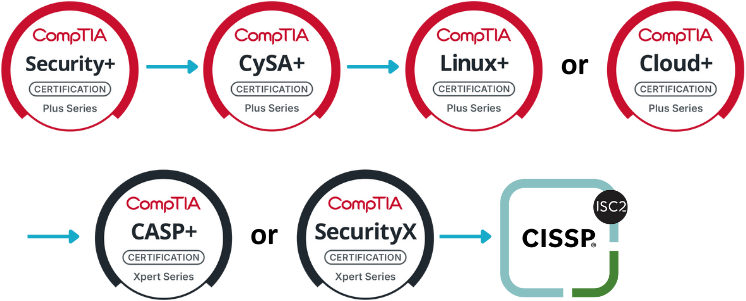
Key Responsibilities:
Operate, harden, and patch Windows/Linux systems; implement STIGs/SRGs; manage AD/GPOs.
Recommended Pathway:

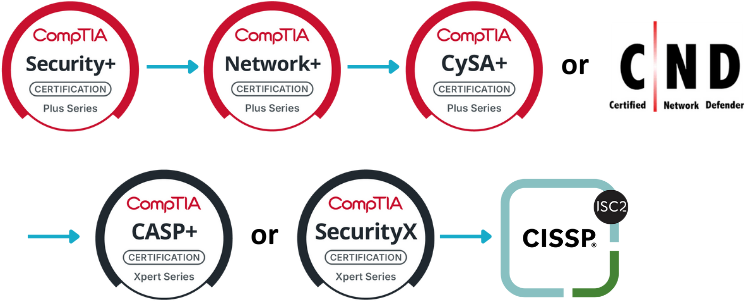
Key Responsibilities:
Run and secure routing, switching, VPNs, firewalls, IDS/IPS; baseline and monitor network health.
Recommended Pathway:

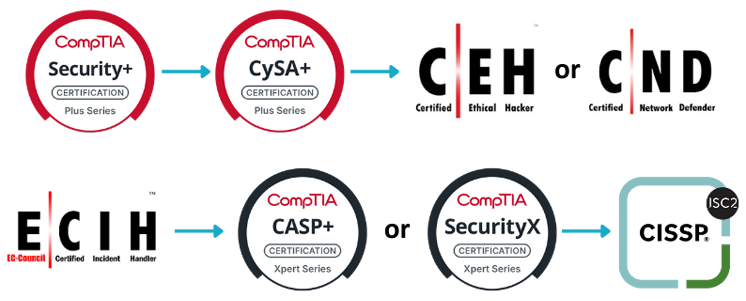
Key Responsibilities:
Monitor SIEM/EDR, triage alerts, create detections, escalate to IR.
Recommended Pathway:

Key Responsibilities:
Scan, validate, prioritize, and track remediation of vulnerabilities; report metrics to leadership.
Recommended Pathway:


Key Responsibilities:
Containment, eradication, recovery, forensics support, lessons learned.
Recommended Pathway:
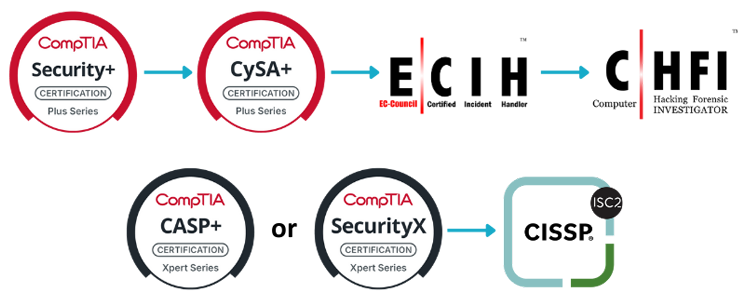

Key Responsibilities:
Oversee cybersecurity programs, enforce compliance with DoD standards, manage security teams, conduct risk assessments, ensure policies are implemented.
Recommended Pathway:
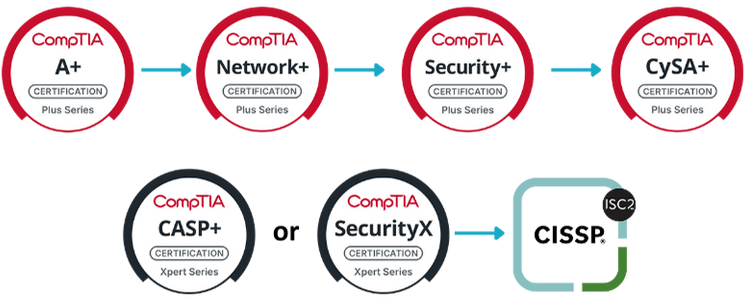

Key Responsibilities:
Research and analyze cyber threats, monitor adversary TTPs, produce intelligence reports, advise defenders on countermeasures.
Recommended Pathway:
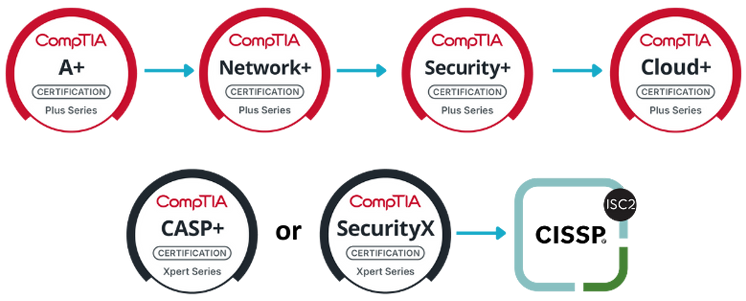

Key Responsibilities:
Conduct simulated attacks, identify vulnerabilities, exploit systems to test defenses, recommend mitigation strategies.
Recommended Pathway:
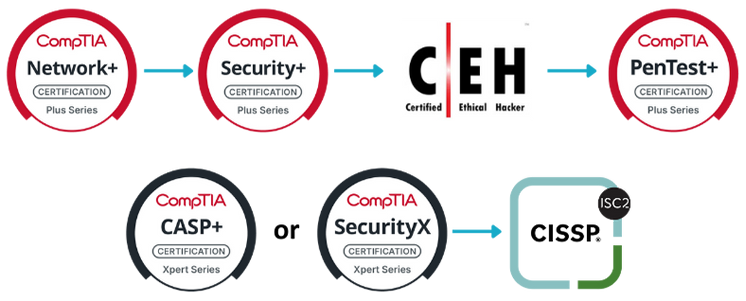

Key Responsibilities:
Secure cloud environments, configure compliance controls, monitor threats in cloud systems, support DoD cloud adoption.
Recommended Pathway:

Key Responsibilities:
Perform digital forensics investigations, preserve and analyze evidence, investigate compromised systems, support legal and incident response teams.
Recommended Pathway: